Friday, December 17, 2010

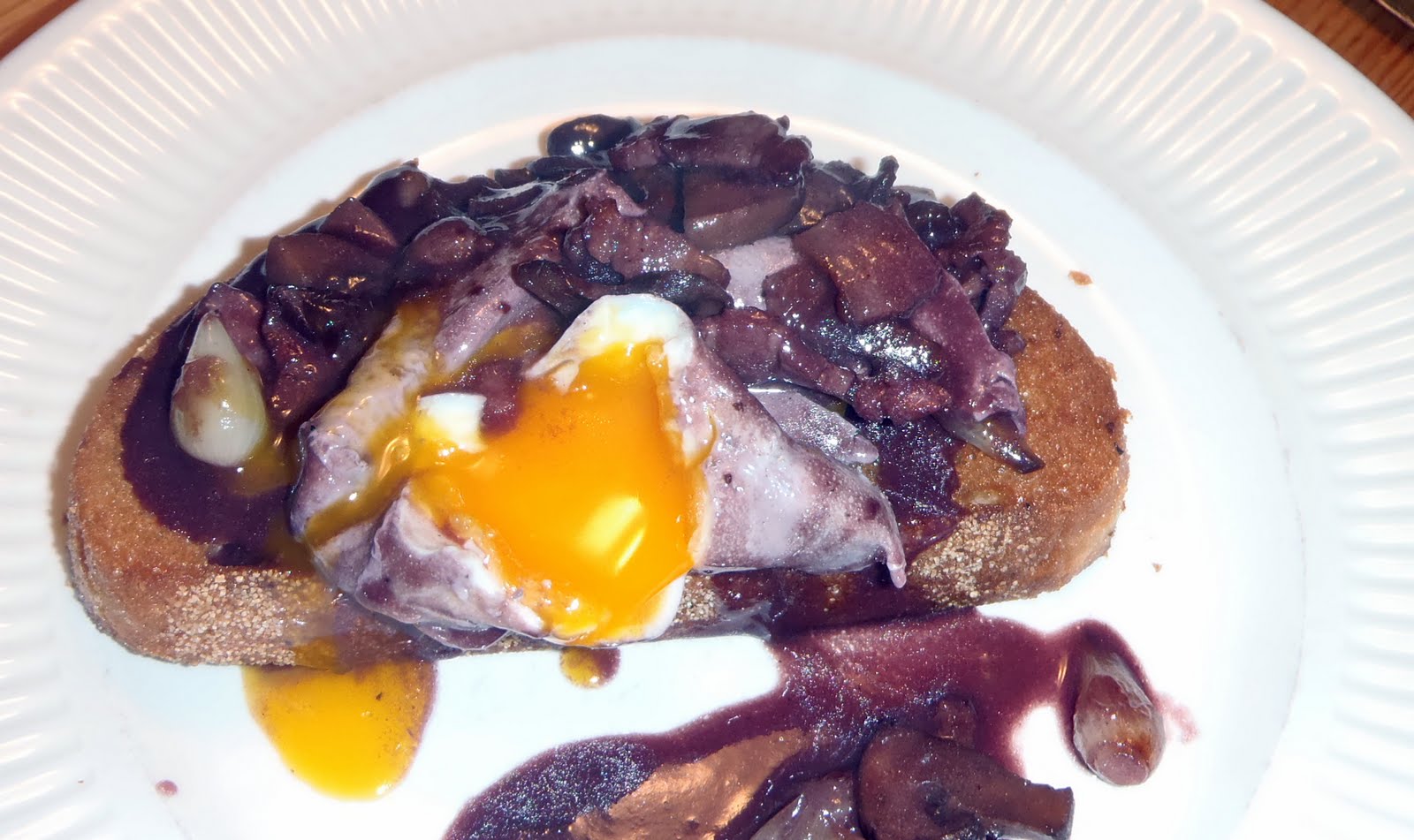
oeufs en meurette (poached eggs in red wine sauce)


Jenn and Jill have challenged The Daring Cooks to learn to perfect the technique of poaching an egg. They chose Eggs Benedict recipe from Alton Brown, Oeufs en Meurette from Cooking with Wine by Anne Willan, and Homemade Sundried Tomato & Pine Nut Seitan Sausages (poached) courtesy of Trudy of Veggie num num.


Let me say straightaway:  This is delicious!!!!  I have poached eggs many times before, so chose this recipe as I'd never made Meurette sauce. I must say, this is one delicious sauce.  I'm not ashamed to admit that licked my plate.  This does take some time to make, and the eggs are going to look really funky as you take them out of the wine and stock combination, but wow... this is so worth it!  After viewing the eggs, my 10-year-old was adamant that he was not going to try this dish.  But he did.  And his response?  "Oh.  This really IS quite good."  

If you have about an hour to spare, and you're looking for a new poached egg experience that is DEEEE-licious, try this.  It's not difficult, only a little time consuming.  Oh, and don't let the purple eggs freak you out.


Ingredients

8 eggs (size is your choice)
1 bottle red wine (750ml/25 fl. oz.)
2 cups (400ml/16 fl. oz.) chicken stock*‡
1 onion, sliced
1 carrot, sliced
1 celery stalk, sliced
1 clove garlic, crushed
Bouquet garni (thyme, parsley, bay leaf)
½ tsp. (2 ½ ml/3g) black peppercorns
2 Tbl. (30 ml/30g) butter
¼ lb. (115g) mushrooms, sliced
¼ lb (115g) bacon, diced‡
16 pearl onions, peeled (200g/7oz.)
Vegetable oil for frying
8 slices of baguette, ¼” (6mm) thick
2 Tbl. (30 ml/30g) butter, room temp.
2 Tbl. (30 ml/20g) flour *
salt and pepper

*for gluten free make sure to use gluten free stock and gluten free flour
‡ for vegetarian use vegetable stock, and omit bacon.

Other notes on ingredients:
  • You can use salted or unsalted butter, you will just have to adjust your "salt & pepper to taste" accordingly.
  • As this is a Burgundian dish, a full-bodied red wine like a pinot noir is a great wine to use for this dish. Anne Willan recommends a fruity red wine. She also notes that you can make ouefs au mersault. Mersault is the famed white wine region of Bourgogne, and is generally made using chardonnay grapes, so it would be ok to choose a white wine if you want. No matter what wine you choose, make sure it is not too dry nor too sweet.  I had a bottle of chianti on hand, so used that and it turned out lovely.
  • As this is a To make a bouquet garni, just take the herbs (a few sprigs of each) and tie them together into a little bundle. Since the sauce will reduce for a while, it’s ok if you don’t have the fresh herbs – there will be time for flavor to come out of dried ones (for ex. fresh bay leaf may be hard to find). Alternatively, if you don’t have a way to tie them, you could just add the whole sprigs/bay leaves to the sauce and then just make sure to remove them when the sauce is done reducing.
 
Directions:

1. Heat wine and stock together in a large pan and poach eggs a couple at a time for 3-4 min. Yolks should be firming but still a little soft. Set them aside.

2. Add the veggies, herbs, and peppercorns to the poaching liquid and let the sauce simmer until reduced to half volume. This will become the meurette sauce.

3. In a separate large skillet, melt 1 tbs. (15ml/15g) of the butter on medium-high heat and sauté the mushrooms until soft and then set aside. Add in another 1 tbs. (15ml/15g) butter and the bacon, frying until browned, then set aside on a paper towel. Turn down the heat to medium, add in the pearl onions and sauté until softened and browned. Then drain off the fat and add the bacon and mushrooms back to the pan and set aside off the heat for the moment.

4. In a medium skillet, heat a few tbs. of oil and then fry the baguette slices until browned on each side. Add more oil as needed. Set the fried bread (croûtes) on a paper towel and then place on a baking sheet in an oven that is set to 200F/95C/gas mark 1/4 or whatever your lowest setting is to keep them warm.

5. Blend 2 Tbl. (30ml/30g) butter and flour together to form a paste of sorts that will be used as the thickener for the sauce. Whisk this into the reduction sauce until the sauce starts to thicken.
Strain the sauce over the skillet of mushrooms, bacon and onions, and return the skillet to heat, bringing to a boil. Season with salt & pepper to taste, then set aside again.

6. Reheat the eggs by placing them in hot water for a quick minute. To serve, plate a poached egg on top of a croûte, and then ladle some of the mushrooms/bacon/onions and sauce on top. 

Saturday, November 27, 2010

crostata con la crema (crostata with pastry cream)


The 2010 November Daring Bakers’ challenge was hosted by Simona of briciole. She chose to challenge Daring Bakers’ to make pasta frolla for a crostata. She used her own experience as a source, as well as information from Pellegrino Artusi’s Science in the Kitchen and the Art of Eating Well.


This was a nice, straightforward challenge this month which I enjoyed.  I found the recipe came together nicely and was quite quick to put together.  I also enjoyed that it involved ingredients that I already had at hand.  The boys gave it their thumbs up which is always a bonus!  I will be making this again.

Pasta frolla
Ingredients:
  • 1/2 c. minus 1 tablespoon [105 ml, 100 g, 3 ½ oz] superfine sugar (see Note 1) or a scant 3/4 cup [180ml, 90g, 3 oz] of powdered sugar
  • 1 and 3/4 cup [420 ml, 235 g, 8 1/4 oz.] unbleached all-purpose flour
  • a pinch of salt
  • 1 stick [8 tablespoons / 4 oz. / 115 g] cold unsalted butter, cut into small pieces
  • grated zest of half a lemon (you could also use vanilla sugar as an option, see Note 2)
  • 1 large egg and 1 large egg yolk, lightly beaten in a small bowl
 
Note: Superfine sugar is often also referred to as ultrafine, baker’s sugar or caster sugar. It’s available in most supermarkets. If you cannot find “superfine” sugar, you can make your own by putting some regular granulated sugar in a food processor or blender and letting it run until the sugar is finely ground.


Making pasta frolla:
  1. Whisk together sugar, flour and salt in a bowl.
  2. Rub or cut the butter into the flour until the mixture has the consistency of coarse crumbs. You can do this in the bowl or on your work surface, using your fingertips or an implement of choice.
  3. Make a well in the center of the mounded flour and butter mixture and pour the beaten eggs into it (reserve about a teaspoon of the egg mixture for glazing purposes later on – place in the refrigerator, covered, until ready to use).
  4. Add the lemon zest to your flour/butter/egg mixture.
  5. Use a fork to incorporate the liquid into the solid ingredients, and then use your fingertips.
  6. Knead lightly just until the dough comes together into a ball.
  7. Shape the dough into a flat disk and wrap in plastic wrap. Place the dough in the refrigerator and chill for at least two hours. You can refrigerate the dough overnight.


    Crema pasticcera di zia Lucia
    Ingredients:
    • 2 extra large eggs 
    • 1/3 cup sugar
    • 500 ml milk
    • 3 strips lemon peel about 3" long and 1/2" wide (using a potato peeler to cut the strips makes it easier to avoid cutting the white part of the lemon)
    • 3 tablespoons pastry (or unbleached regular) flour
     
    1. Pour the milk into a pan, add the lemon peel and warm up to well below boiling point. In a mixing bowl, beat the eggs with the sugar until the mixture is bubbly. 
    2. Sift the flour over the egg mixture and beat briefly until it is incorporated. 
    3. Temper the egg mixture with a small quantity of milk, then slowly add the rest of the milk, mixing with a wooden spoon. 
    4. Pour the mixture into the pan and set it to very low heat, stirring at least every couple of minutes. When the froth on the surface disappears completely, the crema starts to feel slightly thicker. From then on stir almost continuously. 
    5. When the crema reaches boiling temperature and thickens, cook briefly (1-2 minutes), then remove the pan from the heat, remove the lemon peel, place the saucepan in a cold water bath, and stir the crema to bring down its temperature. 
    6. While the crema cools down, stir it every now and then to prevent the formation of a film over it.

    Assembling and baking the crostata con la crema:
     
    1. Heat the oven to 350ºF.
    2. Take the pasta frolla out of the fridge, unwrap it and cut away ¼ of the dough. Reserve this dough to make the lattice top of the crostata. Refrigerate this dough while you work on the tart base.
    3. To help roll the crostata dough, keep the dough on top of the plastic wrap that you had it wrapped in. This can help rolling the dough and can also help when transferring the dough to your pan. You can also use parchment paper for this. However, you can also roll the dough directly on a work surface if you prefer.
    4. Lightly dust the top of the dough and your work surface (if you’re rolling directly on a work surface) with flour. Keep some flour handy to dust the dough as you go along.
    5. If the dough is very firm, start by pressing the dough with the rolling pin from the middle to each end, moving the rolling pin by a pin's width each time; turn the dough 180 degrees and repeat; when it softens, start rolling.
    6. Roll the dough into a circle about 1/8th inch (3 mm) thick.
    7. If you used the plastic wrap or parchment paper as rolling surface, flip dough over the pan, centering it, and delicately press it all around so the corners are well covered. Peel away the plastic wrap.
    8. Trim the excess dough hanging over the edges of the pan. Press the remaining dough around the border into the sides of the pan making sure the border is an even thickness all the way around.
    9. Prick the bottom of the dough with a fork in several places.
    10. Take out of the fridge the reserved pasta frolla you had cut away earlier. Roll it with your pin and cut into strips or use cookie cutters to make small shapes (this is not traditional, but it looks cute); or roll with your hands into ropes.
    11. Instead of jam or fruit preserves, cover the bottom of the crostata crust evenly with the pastry cream.
    12. Use the prepared strips or rolls of dough to make a lattice over the surface, or decorate with the cut shapes. (Note: You can use dough scraps to make cookies: see the Additional Information section for some pointers)
    13. Brush the border and strips of dough with the reserved beaten eggs. You can add a drop or two of water to the beaten eggs if you don’t have enough liquid.
    14. Put the tart in the oven and bake for 30 minutes.
    15. After 35 minutes, check the tart, and continue baking until the tart is of a nice golden hue. (Note: Every oven is different. In my oven it took 45 minutes to bake the tart until golden.)
    16. When done, remove the tart from the oven and let cool. If you have used a tart pan with a removable bottom, then release the tart base from the fluted tart ring. Make sure the tart is completely cool before slicing and serving.

    Tuesday, November 16, 2010

    individual chocolate soufflés


    Dave and Linda from Monkeyshines in the Kitchen chose Soufflés as our November 2010 Daring Cooks’ Challenge! Dave and Linda provided two of their own delicious recipes plus a sinfully decadent chocolate soufflé recipe adapted from Gordon Ramsay’s recipe found at the BBC Good Food website.


    I've made soufflés before, but it had been awhile, so I was pleased to see them as our challenge this month.  I made both a savoury and a sweet soufflé, but I wasn't pleased with the crab and artichoke creation.  The flavour was only okay, and it didn't have the rise I was hoping for.  So I dusted off another recipe and tried individual chocolate soufflés instead.  Success!

    The annoying part was trying to take pictures of them before they started to fall.  I did my best!


    Individual Chocolate Soufflés
    (recipe adapted from The America's Test Kitchen "Family Baking Cookbook")

    1/3 cup plus 2 tablespoons granulated sugar
    8 ounces bittersweet or semisweet chocolate, chopped course
    4 tablespoons unsalted butter, cut into four pieces
    1 tablespoon espresso (or 1 T strong instant coffee mixed with 1 T water)
    1/2 teaspoon vanilla extract
    1/8 teaspoon salt
    6 large egg yolks, room temperature
    8 large egg whites, room temperature
    1/2 teaspoon cream of tartar
    2 tablespoons confectioners' sugar


    1.  Adjust an oven rack to the middle position and heat the oven to 400 degrees.  Grease eight 6-ounce ramekins.  Sprinkle 2 tablespoons of the granulated sugar into the ramekins and shake to coat evenly; tap out any excess.  Set the ramekins on a large baking sheet.

    2. Melt the chocolate and butter together in the microwave in a large bowl, stirring often, 1 to 3 minutes.  Stir in the espresso, vanilla and salt and let the mixture cool slightly.


    3. In a medium bowl, whip the egg yolks and remaining 1/3 cup granulated sugar together with an electric mixer on medium speed until the mixture triples in volume and is thick and pale yellow, 3 to 8 minutes.  Fold the egg yolk mixture into the chocolate mixture (this is the soufflé base).  Thoroughly clean and dry the beaters.

    4. In a separate bowl, whip the egg whites and cream of tartar together with an electric mixer on medium-low speed until foamy, about 1 minute.  Increase the mixer speed to medium-high and whip the whites until soft, billowy mounds, about 1 minute.  Gradually whip in the confectioners' sugar until the whites are glossy and form stiff peaks, 1 to 3 minutes.

    5. Fold one-quarter of the egg whites into the soufflé base until almost no white streaks remain.  Fold in the remaining egg whites until just incorporated.  Divide the batter evenly among the prepared ramekins, wiping any filling from the rims with a wet paper towel.

    6. Secure a strip of foil that has been sprayed with vegetable oil spray around each ramekin so that it extends about 2 inches about the rim.  Bake the souffs until fragrant, fully risen and the exterior is set but the interior is still a bit loose and creamy, 10 to 14 minutes.  Serve immediately.